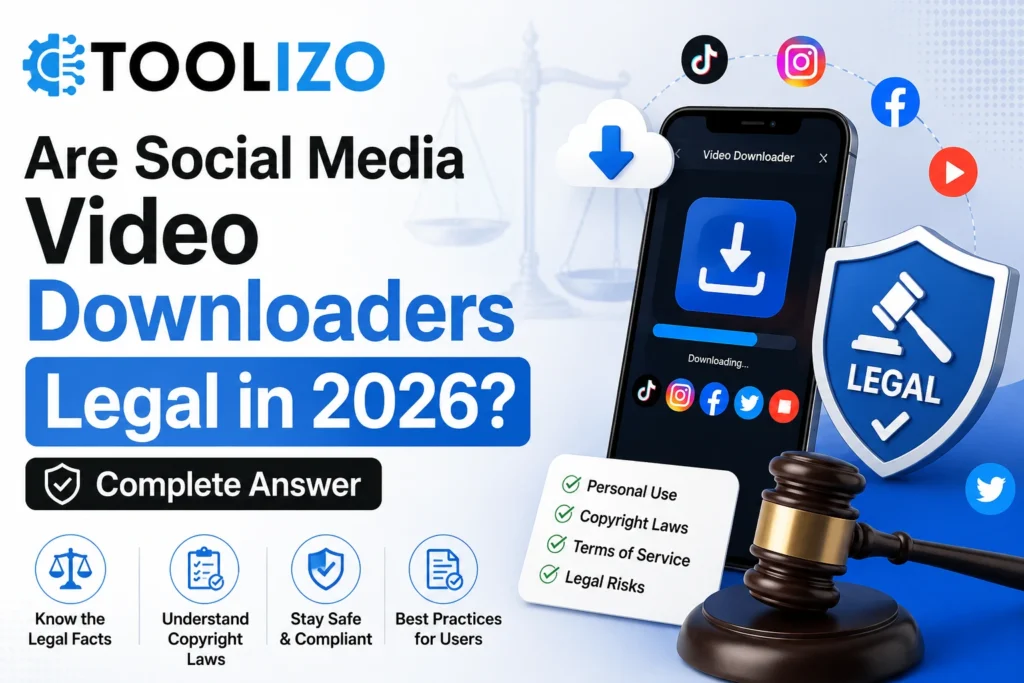
The legality of social media video downloaders in 2026 sits at the intersection of copyright law, platform Terms of Service, and widely accepted personal use practices. The short answer is: downloading publicly available social media content for personal offline viewing is generally treated as acceptable in most countries and is not illegal in the way that piracy of paid content is. However, what you do with the downloaded content after saving it determines whether legal and ethical lines are crossed. This guide gives you the complete picture.
Is Downloading Social Media Videos Illegal
Downloading publicly available social media videos for personal offline viewing is not illegal under the national laws of most countries in 2026. Most copyright law globally recognises some form of private copying exception or fair use principle that permits individuals to make personal copies of content they have legitimate access to. The clearer legal issue is redistribution taking downloaded content and re-uploading it as your own, using it commercially without permission, or distributing it without attribution. That crosses into copyright infringement territory in most jurisdictions. Downloading itself, for personal use, is in a widely accepted grey zone that differs significantly from outright piracy of paid content.
Platform Terms of Service vs Actual Law What Is the Difference
Platform Terms of Service (ToS) and national copyright law are two completely separate things. Violating a platform’s Terms of Service is a contractual breach it may result in account suspension or termination, but it is not a criminal offence and is not the same as breaking copyright law. Most major social media platforms including Instagram, TikTok, YouTube, and Snapchat prohibit third-party downloading tools in their Terms of Service. This means using such tools could result in your account being banned, but it does not make the act criminally illegal in most countries. Understanding this distinction matters enormously for assessing actual risk.
What Does Copyright Law Actually Say About Downloading
Copyright law in most countries protects creators’ rights to control reproduction and distribution of their work. However, most legal systems also include private copying exceptions or fair use / fair dealing provisions that permit individuals to make personal copies of content for private use. In the US, fair use doctrine (17 USC 107) considers purpose of use, nature of the copyrighted work, amount used, and market effect. Personal offline viewing that does not substitute for the original market (i.e. does not reduce the creator’s revenue) has historically been treated favourably. In 2026, a US federal court ruling in Cordova v. Huneault raised concerns about DMCA Section 1201 and bypassing technical protections, but this applies primarily to circumventing paywalls and DRM, not to downloading publicly accessible content.
What You Can and Cannot Do With Downloaded Social Media Content
You CAN: download public social media videos for personal offline viewing and archiving; download content for research, education, commentary, or criticism under fair use principles; download your own previously uploaded content for backup purposes; and share short clips with attribution for commentary or review purposes in most jurisdictions. You CANNOT: re-upload downloaded content to another platform as your own work; use downloaded content in commercial projects or advertising without the creator’s explicit permission; sell or redistribute downloaded content; remove creator credits and present the content as original; or use downloaded content in ways that substitute for or damage the market for the original creator’s work.
Platform-Specific Legal Context in 2026
Each major platform has its own Terms of Service stance on third-party downloading. YouTube’s Terms of Service explicitly prohibit downloading without permission except through its own offline feature or YouTube Premium. TikTok’s Community Guidelines restrict downloading through third-party tools. Instagram’s Terms of Service prohibit scraping and automated downloading. Snapchat similarly restricts external tools. All of these are contractual restrictions on platform use, not criminal laws. The practical consequence is account suspension risk, not prosecution risk, for personal use downloading in most countries.
According to YouTube’s Help Centre, the only officially sanctioned offline download method is YouTube Premium. According to TikTok’s Community Guidelines, users are expected to respect intellectual property. Knowing the platform’s position helps you understand the account risk, even when the national law risk is minimal.
The Ethical Dimension Creator Rights and Attribution
Beyond legal questions, there is an ethical dimension to downloading social media content that matters independently of what the law permits. Content creators on platforms like TikTok, Instagram, and YouTube invest significant time, effort, and resources into producing their content. The ethical approach to downloading is: always use downloaded content for its intended personal purpose; never claim someone else’s work as your own; always credit the original creator when referencing their content in any published format; and reach out to creators directly if you want to use their content commercially. Legal permission and ethical respect are not the same thing being legally permitted to download does not mean anything goes with the content afterward.
From experience: A digital marketing consultant I know uses Toolizo’s suite of downloader tools extensively for competitive research downloading competitor Instagram Reels, TikTok videos, and YouTube content for client briefings and strategy development. She has a clear internal policy: downloaded content is used only for internal analysis and presentation within her agency, is never re-uploaded to any platform, and is never published or distributed externally without explicit creator permission. She considers this standard professional practice that aligns with both the legal fair use framework and basic ethical respect for creator rights.
What Toolizo’s Downloader Tools Are Built For
The downloader tools at Toolizo are built for legitimate personal and professional use cases: personal offline viewing of publicly available content, content research and competitive analysis, archiving your own previously uploaded content, and educational reference. The tools access only publicly available content from public accounts. They do not bypass paywalls, circumvent authentication, or access private content. Using Toolizo tools for the personal and research purposes they are designed for aligns with both the legal framework in most countries and responsible content use practices.
Frequently Asked Questions
Q: Can I get in legal trouble for downloading a YouTube video for personal use?
A: In most countries, downloading publicly available YouTube content for personal offline viewing falls within widely accepted personal use territory and is not criminally prosecuted. The primary risk is account suspension under YouTube’s Terms of Service, not legal prosecution. Consult a qualified legal professional in your country for specific legal advice.
Q: Is downloading TikTok videos legal in Pakistan?
A: Pakistani law does not specifically criminalise downloading publicly available social media content for personal use. Copyright law in Pakistan under the Copyright Ordinance 1962 and its amendments focuses on commercial reproduction and distribution rather than personal copying. Using downloaded content commercially without permission would raise copyright concerns. This is general information, not legal advice.
Q: If I download a TikTok video and re-upload it on Instagram, is that illegal?
A: Re-uploading someone else’s content on a different platform without their permission is copyright infringement in most jurisdictions. The original creator holds copyright to their work. Always get explicit permission before re-uploading content that is not your own.
Q: Are Creative Commons licensed YouTube videos freely downloadable and reusable?
A: Yes. Content published under Creative Commons licences explicitly grants permission for specific uses. Check the specific Creative Commons licence applied (CC BY, CC BY-SA, etc.) to understand exactly what is permitted some allow commercial use, some require attribution, some restrict derivative works. YouTube Studio’s Creative Commons filter lets you find CC-licensed content.
Download Responsibly
The tools at Toolizo Instagram Video Downloader, TikTok Video Downloader, YouTube Video Downloader, and all others are built for legitimate personal and research use. Use them for the purposes they are designed for: offline viewing, research, and content archiving. Always respect the original creator’s rights and never redistribute downloaded content without permission. Explore all free Toolizo tools.
